7/10
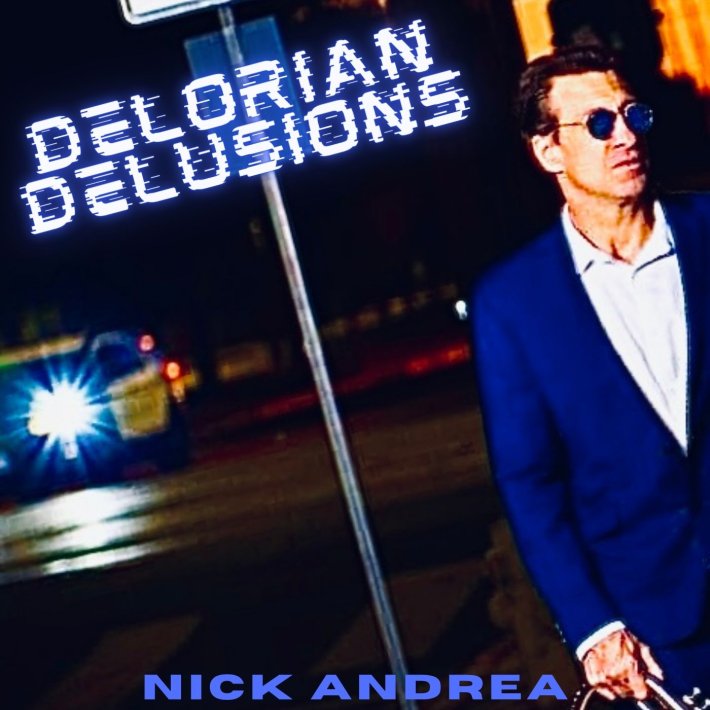
The 80s are often remembered through polished production, towering guitar hooks, sharp suits and songs built for stadium-sized escape. And on his new EP 'DeLorian Delusions', Nick Andrea returns to that familiar decade and strips away much of its gloss, rebuilding four defining rock tracks in a darker blues-rock image.
But this isn't presented as a nostalgic tribute designed to preserve the originals behind glass. Here, the artist treats the material as something flexible, reshaping each song through his own musical instincts and allowing new emotional meanings to emerge. Across ‘White Wedding (Blues)’, ‘Sharp Dressed Man’, ‘Forever Man’ and ‘Money for Nothing’, the album becomes a compact act of reinterpretation that is part homage, part disruption.
Lead single ‘White Wedding (Blues)’ provides the clearest statement of intent. Billy Idol’s original carries menace beneath its swagger, but Nick Andrea pushes that unease further into the foreground. Recast through a stark blues framework, the song loses some of its ceremonial theatricality and gains a bruised, almost funereal weight.
The blues proves an effective vehicle for that shift. Rather than relying on the original’s clipped new wave attack, he appears to favour space, darkness and emotional abrasion. The song becomes less about image and more about consequence, with the weight of the performance resting on what has been endured rather than what is being displayed.
Tracks such as ‘Sharp Dressed Man’ and ‘Money for Nothing’ arrive with particularly strong cultural associations, each tied to the excess, aspiration and visual spectacle of its era. Reworking them through blues-rock offers the possibility of uncovering something rougher beneath those immaculate surfaces. ‘Forever Man’, meanwhile, already sits closer to that tradition, giving him room to deepen its sense of endurance and longing.
Cover albums can easily become exercises in imitation, but 'DeLorian Delusions' is more interesting when viewed as autobiography through borrowed songs. The result is concise but purposeful, as these tracks aim to become conversations between public memory and private grief.
With his new collection, Nick Andrea returns to the 80s while carrying everything that has happened since, and lets the blues reveal the shadows that nostalgia usually leaves behind.