7/10
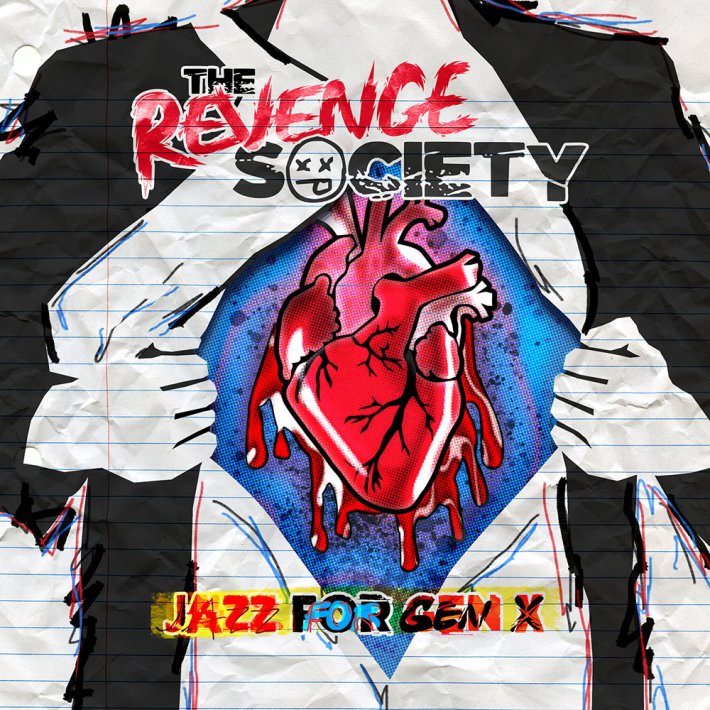
The Revenge Society’s 'Jazz For Gen X' looks to revive the bruised groove of a generation raised on distortion, disillusionment, and downtuned guitars. Clocking in at a lean 45 minutes across 14 tracks, the album plays like a love letter to the alt-rock underbelly of the ’90s; filtered through hip-hop breaks, post-grunge scuzz, and a distinctly modern pulse.
From the opening track 'Ex Machina', 'Jazz For Gen X' sets a clear tone as heavy music for heavy times, with riffs that nod to Helmet’s industrial crunch and Deftones’ woozy dynamics, while still carving out its own lane. The band weaponises groove as much as grit, a curated collision of influences that feels like a nod to their personal canon.
Tracks like 'Lifesaver' and 'Quantum Loop' hum with menace, their jagged rhythms offset by moments of melody that break through like a beam of light in a locked room. At times, The Revenge Society veer into psychedelic sludge à la 'Rated R'-era Queens of the Stone Age, but they never linger long enough to get comfortable. There’s just far too much tension and bite.
One of the standout moments comes in 'Nightshade Lullaby', where guest vocalist Justin Ross adds a spectral layer to the mix. His contribution feels more like a séance, a haunting counterpoint to the surrounding weight. Ross also adds a scorched-earth guitar solo on 'Lucky', injecting a jagged bolt of chaos into one of the album’s most tightly wound moments.
Despite its genre-blending tendencies, 'Jazz For Gen X' never feels overstuffed. Thanks to the deft production by Steven Katz and the sharp mix from autryaudio, each element feels surgically placed. Mastering by Chris Howell at Café Solo Studios gives the record that final layer of polish without sanding off its edges.
In short, 'Jazz For Gen X' is exactly what it claims to be, a record for those raised on riffs and raised eyebrows, and for those of us who remember when rock was weird, loud, and unafraid to feel something. The Revenge Society deliver a potent mix of nostalgia and noise; an album that hits hard, but still leaves space for reflection in the silence after the last note fades.