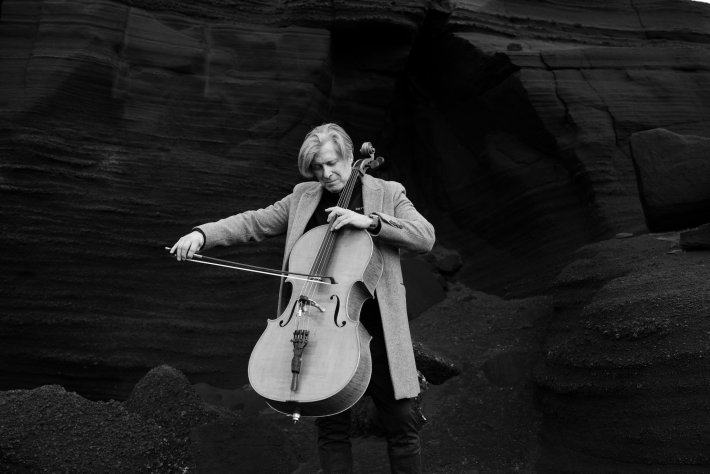
Icelandic cellist and composer Eythor Arnalds continues to carve out a distinctive space between neo-classical composition, ambient minimalism, and cinematic sound with the release of ‘Promenade nr. 7’, the latest preview of his forthcoming album 'Music for Walking', due on the 29th May via Alda Music. Designed not simply as a collection of songs but as a companion for movement, the album explores music as something to move through, an immersive sound world shaped by breath, thought, and the rhythm of walking itself.
Built from a minimal two-note theme, ‘Promenade nr. 7’ unfolds with quiet patience, gradually expanding into a piece that balances calm, tension, and emotional momentum. Recorded at Reykjavík’s Harpa Concert Hall with members of the Reykjavík Symphony Orchestra, and brought to life with the help of conductor Viktor Orri Árnason and producer Bergur Þórisson, the track reflects Arnalds’ gift for creating music that feels intimate, spacious, and deeply transportive.
So with the new single out now, we sat down with him to find out more about his origins and what has been inspiring him most over the years.
-
What was the first instrument you fell in love with?
It was the cello. I played violin when I was seven, then trumpet and piano, but to me the cello was my love. It is very human, shaped like a person and has a range like the human voice. It falls into my embrace to play it. My father played classical music all the time both on the piano and records. His favorite instrument was the cello, so a lot of cello music was played in the home. I guess that sealed my future choice.
What kind of music did you love when you were younger?
I went through different phases, First classical music all the way from Gregorian chant to Stockhausen that my father played at home. Then, when I was 13 I completely changed and got into punk and new wave bands, playing the bass and singing with Björk. To me it was rebellion against the system and tradition, but also the first period of making my own music. I worked with many great musicians experimenting with composition using chance, recording in new ways and using classical and electronic instruments together.
What was the first album you remember owning?
The „White album“ by the Beatles when I was a kid. It contains a broad range of styles of music including the experimental „Revolution 9“ with tape loops. I am brought up with classical music and this album opened a door for me into different worlds.
What is the one song you wished you could have written yourself?
Prelude nr.3 for solo cello by J. S. Bach. It is a gem I keep playing. The prelude is grand in harmony but still mostly one note at the time. It is less known than the prelude of the first cello suite, but I find it has more spiritual energy.
Do you have any habits or rituals you go through when trying to write new music?
I try to find the essence of the idea and work with it. Find new perspectives on the idea and focusing on it. Grow the theme as an organic being. Like a seed that becomes the fruit. The late Louis Andriessen taught me that having two ideas in a piece may be too much. Sometimes we need to limit and define the inner laws of the piece to attain purity. I am often working inside the constraints of the harmony of the piece like a painter that has a limited canvas and perhaps a frame. To me that discipline creates energy and purity in the music.
Who are your favourite artists you have found yourself listening to at the moment?
I have recently been listening to Henryk Gorecki who created these slow sorrowful orchestral and choir works that have elements of classical, epic spiritual mood and beautiful sorrow.
If you could open a show for anyone in the world, who would it be?
I think it would be Arvo Part, on of the greatest composers alive. His music is almost sacred in its purity and his essence is both very human and very spiritual at the same time.
What do you find is the most rewarding part about being a musician?
Hearing my music played by other musicians as it takes on a life of its own. Hearing a group of musicians bring the score to life is magical. It is like seeing one's baby walk.
And what is the most frustrating part?
Things take time. Sometimes more time than expected. I am sometimes impatient, but that is improving with age.
And what is the best piece of advice you have received as a musician?
Everybody makes some mistakes but the difference lies in how you react to them. Whether you stumble or give up or whether you continue is crucial. Persistence is key. Atli Heimir my composition teacher said to me: „The difference between the good pianists and the bad is that the bad ones falter or stop but the good ones continue and elaborate from the wrong note“.
-
Eythor Arnalds' new single 'Promenade nr. 7' is out now. Watch the video for it in the player below.