
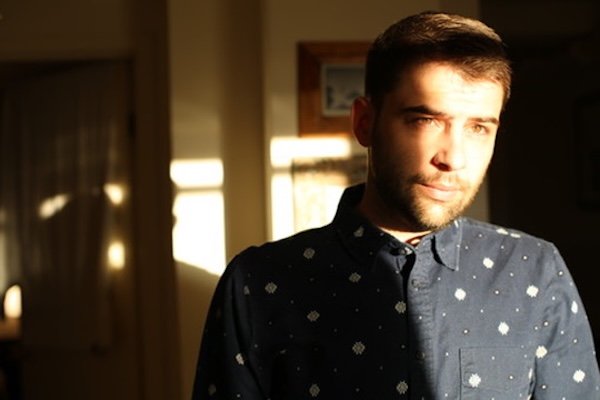
Brooklyn-based singer-songwriter and producer Atticus Kane returns with 'News From Delphi', a richly textured collection of alternative folk-pop and reflective songwriting that explores relationships, uncertainty and the search for meaning in a rapidly changing world. Marking his most collaborative project to date, the album pairs Kane's introspective storytelling with a broader sonic palette shaped alongside collaborators Lucas Murray and Simon Thomas George.
Born in Budapest before relocating to the United States as a teenager, Kane's music has long been informed by ideas of movement, identity and perspective. With 'News From Delphi', those themes take centre stage, resulting in his most expansive and emotionally resonant work yet.
So with the new album available to stream now, we sat down with him to find out more about his origins and what has been inspiring him most over the years.
-
What was the first instrument you fell in love with?
The first instrument I fell in love with were drums. Perhaps because my dad plays the guitar, and because he’s tried to teach me from an early age, I resisted taking it seriously. Drums were all mine though–no one I knew played them. I remember spending countless hours in the garage of our house (I’m sure to the chagrin of my parents and neighbors) practicing. Maybe it is odd for a songwriter to be drawn to a rhythm instrument but to this day I strongly believe that the combination of drums and bass are the key anchors of song production. The right beat and groove can make or break a song.
What kind of music did you love when you were younger?
I loved listening to my dad’s record collection as a child. Particular favorites were Bob Dylan, The Beatles, the Rolling Stones, Led Zeppelin, to name a few. However, there is a Hungarian musician called Judit Halász. Her music was the soundtrack to my early childhood. She is universally loved across the country, there are 3-4 songs of hers you could start singing in the middle of the street and people would join in, knowing all the words by heart. Her sound combines elements of Hungarian folk music and country rock. She incorporates the pedal steel into her sound which is such a beautifully unique instrument. Her sound is the inspiration for my album News From Delphi—like her, I wanted to incorporate the pedal steel in a way we don’t usually hear.
What was the first album you remember owning?
The first album I remember owning was Shania Twain’s Come On Over. There is a funny trivia about this album: there are two versions of it. The ‘international’ issue of her album available in Europe (and therefore to me) is full of electric drum loops and synthesizers. I did not care for this version. It took me a lot of effort, and an eventual trip to the US, to get my hands on the ‘American’ version of the CD. This album is such an interesting case study of what happens when cultures and genres get mixed. While most of us would consider it country music (I’m talking about the American version), it was written by a Canadian and a South African, recorded in New York by an Australian and a Swedish engineer. Maybe this is why it has such a wide appeal. Or maybe it’s the quality of the songwriting. It is impressive that such global hits as “That Don’t Impress Me Much” and “Man! I Feel Like a Woman!” are grounded in an empowering and even subversive message of reversing traditional gender roles.
What is the one song you wished you could have written yourself?
There are too many to count! But if I have to pick one, it would be Only a Pawn in Their Game by Bob Dylan. I don’t know what you were like at 23 years old, but the idea that you could write a deeply meaningful and shockingly poignant song like Only a Pawn in Their Game at such a young age is in itself baffling. Yet, he did it. Listening to the song today, with what the state of the world is, sadly, the frustrations voiced by Dylan are just as vital as they were when he published it in 1964. From the first line "A bullet from the back of a bush took Medgar Evers’ blood” you are hooked and you are overtaken by the urgency of Dylan’s message. I live close to Brooklyn’s Medgar Evers collage and every time I get to my subway stop (called ‘Franklin Avenue-Medgar Evers College’) I think of this song and its message. As we celebrate America’s 250th birthday, this song is a reminder that the work of creating a more perfect union is far from complete and that we have to keep fighting to ensure that the powers that be cannot treat citizens as ‘only a pawn in their game.’
Do you have any habits or rituals you go through when trying to write new music?
I have many ideas recorded as voice memos on my phone and my usual process is to return to one of these ideas. For me, one of the most exciting part of songwriting is that you never quite know when the inspiration will strike. Whether I’m standing in line at the grocery store, about to fall asleep, or commuting on a crowded subway, a melody or an idea can pop into my head. I have experienced a few awkward moments of humming a new idea into my phone’s voice memos as people around me quietly judged. It’s always fun to rediscover these gems and flesh them out into full songs.
Who are your favourite artists you have found yourself listening to at the moment?
Right now, I'm completely captivated by an artist named Jibril Zinedine. I first came across him on Instagram, where he went viral for these raw, mesmerizing videos of himself singing traditional French tunes while walking through a pedestrian tunnel. The natural acoustics of the tunnel combined with his tremendous, soulful voice made it impossible to scroll past. It’s been incredible to watch his trajectory from a DIY social media phenomenon to a fully signed artist with Universal Music. He’s just a pure joy to watch and listen to. Alongside him, Joy Oladokun has been on heavy rotation for me lately. Her songwriting occupies this rare space where it feels both instantly modern and completely timeless. The tracks are incredibly catchy, but if you look beneath the surface, the lyricism is deeply profound. Her album In Defense of My Own Happiness is an absolute masterpiece and a particular favorite of mine.
If you could open a show for anyone in the world, who would it be?
Without a doubt, Courtney Barnett. She is obviously a towering talent and a brilliant songwriter, but what I admire most is how she carved out her own lane. She created a completely unique, unmistakable sonic identity and proved to the industry that you can achieve global renown while remaining fiercely, unapologetically true to who you are and what you represent. She completely redefines what it means to build a successful career on your own terms. Plus, from everything I've seen, she just seems like an incredible person to hang out with. I have a feeling a tour with her would be an absolute riot.
What do you find is the most rewarding part about being a musician?
The most rewarding part of being a musician is seeing people respond to, being affected by and even moved by the songs I write. There is an immense amount of unseen labor that goes into a single track; from the initial spark of writing the lyrics, to tracking the instruments, to the meticulous process of mixing and mastering. Throughout that entire production cycle, only a handful of people ever hear the song. By the time you’re finally ready to release it into the world, you’ve listened to that track hundreds of times. You become so intimately familiar with every single frequency and detail that it becomes almost impossible to listen to it objectively. That’s exactly why that moment of release is so magical. When you finally get to witness someone experiencing the song for the very first time as a complete, fully realized piece of music, and you see it resonate with them, all that isolated hard work instantly feels worth it.
And what is the most frustrating part?
The biggest frustration is the constant tug-of-war between the art and the administration. Naturally, you want to spend all your time in the creative zone: writing, experimenting, and recording. But the reality of being a working independent musician today is that you also have to act as your own public relations firm, marketing director, and content creator. You don’t start out with a massive support team to handle the noise for you. Personally, I’m not someone who is instinctively drawn to social media, nor do I have a burning desire to study the inner workings of platform algorithms. Yet, to actually find and connect with your audience, you're forced to dedicate countless hours to learning content strategy. By the time you’ve edited videos, formatted photos, and tailored posts for three different platforms, it’s hard not to feel a bit depleted. It is, however, incredibly rewarding when you do make those genuine connections with listeners, even if the sheer volume of time spent on self-promotion can sometimes make you feel like the actual creation of your art has been pushed to the back burner.
And what is the best piece of advice you have received as a musician?
The best advice I’ve ever received to protect my creativity is a simple one: allow yourself to be bored. We live in a culture where every micro-moment of downtime is immediately hijacked by content. The second we aren't actively doing something, our instinct is to pull out our phones and start scrolling. But there is a quiet power in boredom and letting your mind wander. It’s during those blank spaces, when you aren't consuming someone else's output, that you actually process your own thoughts and feelings on a deeper level. It’s where you daydream, imagine scenarios, and let ideas collide. Having absolutely nothing to do is often the absolute best way to let your mind drift and give your creative juices the space they need to start flowing again.
-
Atticus Kane's new album 'News From Delphi' is out now. Check it out in the player below.