
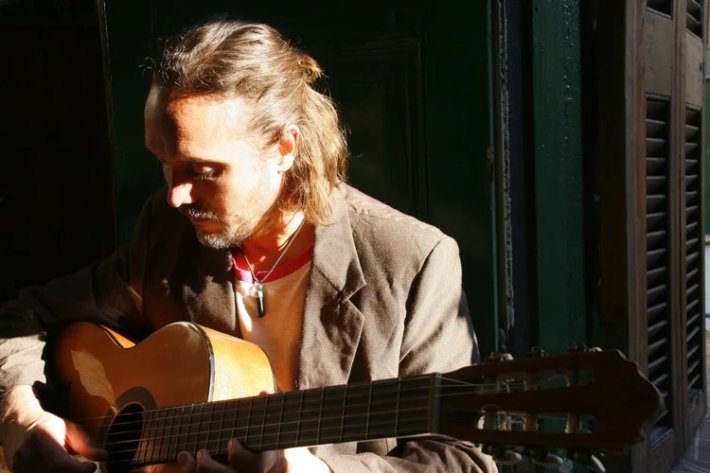
For Brighton-based songwriter Nik Barrell, music has always been a way of navigating life’s most uncertain terrain, but with his latest single 'Lost', that journey becomes literal. Written and recorded entirely on the road in his self-built van-studio while travelling solo through Spain and Portugal, the track is a haunting meditation on grief, identity, and the quiet beauty of disorientation.
Emerging from a winter of solitude, long drives, and personal upheaval, 'Lost' channels that fragility into something deeply resonant. Atmospheric and emotionally charged, the single captures the sound of landscapes passing by, the hush of mountains, and the flicker of hope in stillness.
The track is taken from his new EP 'Almost Home', a companion project to 2022’s 'Home', both shaped by his life on the road in his van “Bertie Van Doogle”, a converted Renault Master turned mobile studio and sanctuary. With drums recorded in the Portuguese mountains and visuals created through hand-drawn animation, Barrell’s work stands in defiant contrast to our digitised world: human, raw, rooted in presence and place.
So with the new single out now, we sat down with him to find out more about his origins and what has been inspiring him most over the years.
-
What was the first instrument you fell in love with?
The first instrument I fell in love with was this crazy old piano we had in my family house. It was a bit out of tune, but also some of the bass notes were completely broken. One of them just made a kind of clunk sound. Another one made a sound a bit like a ride symbol, but a very strange one. I used to play a lot and do kind of drum patterns with my left hand, mixed in with bass notes and other strange sounds the piano could create, while playing chords or melodies with my right hand. I had no idea what I was doing, but it was extremely free creative and fun.
What was the first album you remember owning?
When I was about seven, I had exactly 3 records. One was a valentines gift from my first ever girlfriend. It was Buddy Holly’s love songs. What an incredible first gift. She couldn’t imagine I’m sure what an impact it would have on my life. Buddy Holly is such a great writer and musician he’s influenced everyone. I also had the jungle book, with lots of Louis Armstrong of course. Another blessing. And I had a strange record which I absolutely loved. It was just a collection of bird songs. On one side there were single , like the blackbird or the owl. Each track was just a few minutes long. On the other side, it was kind of environments, like the sound of a jungle, or the sound of a meadowstill - mainly focusing on birds. I used to put that on and it was like some kind of Zen meditation for me at that age.
What kind of music did you love when you were younger?
When I was really little, I could remember my mum she used to sing a Supertramp song to me called ‘give a little bit’. I remember absolutely loving it, but then I was growing up I got really into very old blues. Chicago blues and 60s music. I remember going away on a school camp. Everyone was listening to eighties pop and I couldn’t understand why at all. Now I don’t mind it so much, but at the time it felt soulless. I remember disappearing into my Walkman and listening to Muddy Waters, old stones Records and Crosby, Stills, Nash & Young and wondering what on earth had gone wrong with music. Teenagers are very black-and-white.
What is the one song you wished you could have written yourself?
It’s an interesting question. There’s lots of songs I really love of course, but lately I’m really aware of how personal song is. I’ve been doing quite a few shows lately in little bars and places where I often play a mix of old blues, jazz, some famous songs and my own songs. I expected the audience to respond best to famous songs, which they do to an extent, but actually what they respond best to is when I really connect the song. So the best kind of cover to do turns out to be not so much about it being famous, but about how much I connect to it. When I play my own songs, which of course I can’t help but connect to, I can really feel the energy in the room changing. I often don’t introduce them as my own songs, so the audience doesn’t necessarily know, but I can sense a real change and how they respond. It’s a kind of deeper response. The whole room seems to go on a journey of connection together, mostly quite unconsciously. And it’s really beautiful, we all feel it. I think right now, we all really need it.
Do you have any habits or rituals you go through when trying to write new music?
Yes, lots. I’m always trying new things and going back to old tricks too. Over the years one thing I’ve learnt and that I still apply, is to be both as disciplined and as free as possible. I write all the time, but I like to go through a period of deep writing where I write every day for a month or two. Sometimes writing feels like exercising a muscle, if you regularly do one or two hours every day for a month or so, songs just seem to come easier and easier. So that’s the discipline part. It’s about turning up and committing. The freedom part comes from the attitude you have when you turn up. I tried to keep a really open mind about what a song is, or wants to be. Maybe there’s no verse in this song, maybe there’s two choruses, maybe it’s only two minutes long? There’s a balance to be had between not trying hard enough to find the form the song naturally has and ruining its natural form by having preconceived ideas of what it should be. I think you have to birth a song very gently and stay playful and light, curious rather than demanding. Then sometimes you find yourself with this rather beautiful thing in your hands and you don’t even know quite how it got there.
Who are your favourite artists you have found yourself listening to at the moment?
I went through a phase of fairly obsessively listening to The Villagers. Right now, I’m a bit crazy on The Bobby ‘Blue’ Band. I really love Kevin Morby at the moment I’m recently got in touch with his producer Sam Cohen. We’ve decided to become penpals. He seems like a really lovely guy and a kindred spirit.
If you could open a show for anyone in the world, who would it be?
Definitely Little Richard, although of course he’s not with us anymore. If you haven’t read his autobiography, you should. It’s completely mindbending. It would be terrifying opening for Little Richard, because his shows were so good. Pure entertainment. But if I did open a show for him, we’d get to hang out and I’d get to watch his show, so that would be perfect.
What do you find is the most rewarding part about being a musician?
Connection. Connecting to the song. Connect to yourself through the experience of creation. Connecting to the audience. Connecting to other musicians and most deeply: connecting to this mysterious thing; this spirit, called Music.
And what is the most frustrating part?
I think all the assumptions about music and success that you have in yourself, that audience members have, the society has. All these assumptions about what music is, about what a musician is, about why you’re doing music and the purpose of music in life are really confusing and unhelpful. These things can really lead you down some dead ends. It can take such a long time and can be so painful to figure out that none of these assumptions are relevant. What’s relevant is your journey, your true feelings about music, your purpose, what music does for you and actually that journey of discovery is not some kind of waste of time while you try to achieve success. It’s the whole point. It is success.
And what is the best piece of advice you have received as a musician?
An old friend of mine when I was about 15, who was one of the guys that I grew up playing music with and was an incredible talent, gave me a bit of advice. He said just focus on the music and forget about everything else. I still think that’s basically the secret. Yes, you have to book gigs, do Instagram posts, organise bands, pay the bills etc etc worry about whether you’re good enough, get caught up thinking you’re a genius occasionally and a million other distractions. It’s all fine, as long as you don’t forget to keep putting the music back in the centre. In a way, it’s like doing some kind of meditation your mind wonders and then you keep bringing it back to the music. Your mind wonders again and then you bring it back to the music. Your mind wonders again and you bring it back to the music. This practice - this discipline, over time, brings some kind of deep connection and peace with music itself, which is way bigger and more rewarding than you can imagine. It may or may not bring you fame and fortune, but it will bring you peace and purpose and in the end that’s worth a lot more.
-
Nik Barrell's new single 'Lost' is available to stream now. Check it out in the player below.