
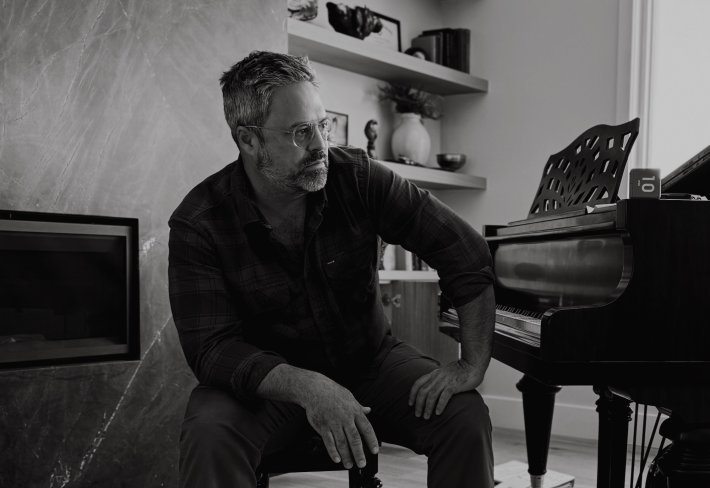
Some albums are carefully planned, while others arrive when they’re needed most. For Utah-based pianist and composer Reese Harper, 'A Waltz in the Woods' began as a way to navigate a period of profound personal change. Following the collapse of long-held foundations in his life, Harper retreated to a mountain cabin, where quiet improvisations at an upright piano gradually became a deeply personal collection of compositions rooted in grief, healing and hope.
Blending intimate piano performances with cinematic minimalism and subtle ambient textures, 'A Waltz in the Woods' favours emotional honesty over technical perfection. Each piece feels less like a performance and more like an invitation to pause, reflect and reconnect, creating music that accompanies life’s quieter moments rather than demanding attention.
So with the new album out now, we sat down with him to find out more about his origins and what has been inspiring him most over the years.
-
What was the first instrument you fell in love with?
Probably the voice. Singers. I remember being really little, listening through these speakers — my mom had just got these high-end speakers for the time — and looking at album covers, images of all these artists. I remember listening to James Taylor. His voice stood out to me more than any instrument did. I didn't really think about instruments back then, I just thought about the lead voice. It's funny — I wonder now if that plays into my piano playing, because the tracks on the album are pretty melodic compared to other piano composers I've listened to. A friend recently told me, "I don't know what this is — I don't really listen to this type of music, but I'd listen to this again." That felt like a high compliment. Like, I hate your category, but this I'd listen to.
What kind of music did you love when you were younger?
I was conflicted, honestly — I grew up in a fairly religious home, so there was approved music and there was popular music. I liked the popular stuff a lot, but I liked the religious music too. So it was Kenny Loggins, James Taylor, Carly Simon, Carole King — that was as edgy as it got. The 70s were still considered cool. Classically, I loved Rachmaninoff, Beethoven's symphonies, Chopin — I thought Chopin was brilliant, and Erik Satie too. That whole melodic, romantic period was really compelling to me.
And then later — Nerd, Kurt Cobain, Alanis Morissette, Collective Soul, Green Day's Dookie — that was sixth grade for me. Punk rock was still cool, Bad Religion was on the tail end of cool, Metallica too. There was a four-year stretch where the only approved album in the house was the Black Album, so that's all we listened to.
What was the first album you remember owning?
The first one I bought with my own money was Jagged Little Pill — Alanis Morissette. I think it beat out Oasis's (What's the Story) Morning Glory by a year. It might have been Collective Soul, but I'm pretty sure those all came out around the same time.
What is the one song you wished you could have written yourself?
That's hard — popular and classical live in totally different worlds. Randy Newman is a huge influence for me now, even though I wasn't listening to him as a kid — I was full punk rock back then. If I have to pick one, I'll say "You've Got a Friend in Me." Not necessarily because it's my favorite, but because the message is so universal.
Do you have any habits or rituals you go through when trying to write new music?
I think it's important to sit with where you're at before you start — what you're feeling, what's on your mind, what's happened recently. I sit on the bench for a bit first. I don't pick a place to go, exactly — I just jog through recent memory, think about who I was with that day, what we talked about, and then I start playing. I find I play most naturally at night, after a full day of taking in work, conversations, feelings. A lot of people struggle just to get through their day — and sometimes music is the only place you can actually process all of that.
Who are your favourite artists you have found yourself listening to at the moment?
Noah Kahan — Stick Season. It's almost embarrassing to say because it's so popular, but it's just good. I don't mind liking something everyone likes right now. Before that I went through a Rosalía phase — Motomami era — and before that I went back to classics for a punk rock stretch. Right now I'm still deep in Noah Kahan, so don't force me to move on yet.
If you could open a show for anyone in the world, who would it be?
Right now? Noah Kahan. Or Rosalía — if she's reading this, she's absolutely listening.
What do you find is the most rewarding part about being a musician?
Getting to feel the feelings of the instrument you play as they come through — there's nothing like it. If you haven't played an instrument, it's hard to explain, but if you sing, you get there too. Just getting to do that is the gift.
And what is the most frustrating part?
You have to pay your bills, so music's a challenge to fit in. I'm not at a place where I can do this full-time — even though it's basically my second full-time job. It's not really about the money, it's about carving out the time. Getting consistent with rehearsing and playing — I wouldn't have an album if I hadn't done that consistently. Figuring out what space you can create in your life, physically and in your schedule, to make it happen — that's been the real challenge for me.
And what is the best piece of advice you have received as a musician?
I feel like I only just became a musician when I released this album — even though I've always played. I think it's because you have to find the medium to share through, one you genuinely respect. For me, it felt real when I started playing what I wanted to play — what I actually heard in my head — and gave myself permission to play that. That's when it became a different game. Now it's fun, because I'm just trying to make the noise that's in my head, or see what shows up when I sit down and wait.
So — the best advice I've ever gotten is simply: don't give up. And I'd add to that: carve out the time, and keep experimenting with what sounds good to you. That's what's helped me find my rhythm more in recent years. I didn't have that before.
-
Reese Harper's new album 'A Waltz In The Woods' is out now. Check it out in the player below.