
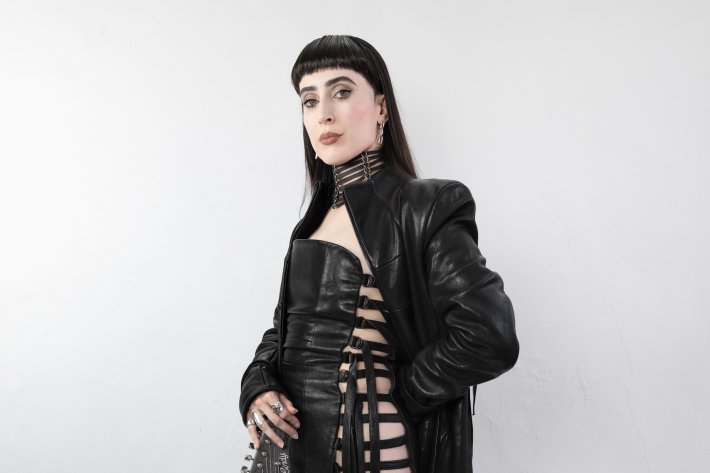
New York singer-songwriter Scout Paré-Phillips returns with 'Claw', a powerful and deeply personal lead single from her forthcoming third solo album, 'Lupine Daughter'. First gaining recognition as one half of post-punk country outfit The Sterling Sisters, and later performing alongside Jack White, Scout has steadily built a reputation for fearless songwriting and emotional honesty.
Written while processing a lupus diagnosis and the loss of her father, 'Claw' confronts illness, grief, and resilience with striking directness, pairing the rich tones of a custom baritone guitar with cello, pedal steel, and drums to create an atmosphere that feels both intimate and immense.
So with the new single out now, we sat down with her to find out more about her origins and what has been inspiring her most over the years.
-
What was the first instrument you fell in love with?
My entry into playing music was the trumpet. Beginning when I was around 11 years old, I played in big band, orchestral, and jazz ensemble settings throughout my adolescence. I remember being obsessed with Chet Baker and Miles Davis, and the idea that the embouchure is like a horn player’s distinct voice. I met my lifelong music mentor, Jonathan Elliott, playing trumpet in his jazz ensemble. I fell in love with composing under his guidance, while concurrently playing guitar and singing in rock bands around New York City beginning at age 12 – something totally unrelated to my musical training at that moment in my life, until I joined the classical voice program as a teen.
What kind of music did you love when you were younger?
I listened to almost exclusively post punk in high school: Nick Cave, Rowland S. Howard, PJ Harvey, Tom Waits, Gun Club, Portishead -- and of course songwriters like Leonard Cohen and Jeff Buckley permeated through. I remember as a kid discovering a lot of artists through Steve Van Zandt’s “Little Steven’s Underground Garage” radio show up in Woodstock. A little younger than that, I listened to whatever alternative and punk music permeated through radio and early streaming platforms: Joy Division, X, The Cramps, X-Ray Spex, Gang of Four, Echo and the Bunnymen, and The Cure. Popular alternative music around that time would have been when The Strokes, the Yeah Yeah Yeahs, Interpol, and the White Stripes were all dominating with their debuts. My father was a country musician, so that music was omnipresent throughout my childhood as well: Johnny Cash, Roy Orbison, Patsy Cline, Hank Williams, Elvis, Willie Nelson, George Jones, etc. My mother exposed me to a lot of jazz, classical, and world music; I think to this day, I could sing along to any Billie Holiday or Etta James song.
What was the first album you remember owning?
Ah, I’m actually not sure – I recall asking my parents to get a CD of something we heard on a country radio station when I was around 5, but I don’t recall what it was. As I started choosing my own music, it was more about making mix CDs for friends and to listen to in the car.
What is the one song you wished you could have written yourself?
This is a tough question! Possibly “Wicked Game” by Chris Isaak, for how iconic the melody is and expert use of a more country vocal cracking technique, in the context of a ballad. I remember hearing this song when I was around 10 or 11 years old and trying to learn as much as I could about Chris Isaak; I felt he was somehow magical. I was always relieved to hear that technique embraced, because in classical vocal training, you are encouraged to smooth the passaggio (break between head and chest vocal registers), but I listened to my dad yodeling and country singers dig into it. It was really hard for me to blend when I was young.
Do you have any habits or rituals you go through when trying to write new music?
Nearly every song begins with a melody, sometimes with loose lyrics already taking shape in vowel sounds. That quick sketch gets captured on a voice memo (usually while I’m doing something totally mundane and unrelated to music). Then at some point later, I’ll sit down with my guitar and figure out the chords, build a song around it, and tell the story of whatever I’m going through at that moment.
Who are your favourite artists you have found yourself listening to at the moment?
As far as new releases which I’ve been enjoying recently, I thought Sharon Van Etten did a great job on her new album with Attachment Theory. The fretless basslines are just delicious. Beth Gibbons’ new solo release, Lives Outgrown, was phenomenal in concert. I make a specific effort to pay attention to how other female contemporary artists are developing their sounds and production – even more towards the pop world, like Mitski or Florence and the Machine, who are recent discoveries for me. I find it intriguing to think about in ‘mainstream’ music, with these big contracts where money is not as much of an object, how far production can be pushed – or when it’s overshot. Like Jessica Pratt’s music is perfect just as it is, with a couple of her vocals and nylon stringed guitars layered. Nick Cave, Rowland S. Howard, Jeff Buckley, Leonard Cohen, and PJ Harvey will be my constants forever. Seeing PJ live for the first time a couple years ago with my bandmates was so, so special. I’ll remember that for life. I’ve also had the honor of meeting and playing with great local bands like Camp Saint Helene and Leathered, and love their music. I’m very excited to hear what Emma Ruth Rundle’s new album will sound like! Ora Cogan is another phenomenal female artist I discovered when her band opened for Emma in New York City. As I age, I recognize it’s important to stay connected to peers in the industry and support one another.
If you could open a show for anyone in the world, who would it be?
PJ Harvey
What do you find is the most rewarding part about being a musician?
Processing and expressing challenging experiences in songwriting, and having others be able to relate to some of these emotions – connecting with other people, in this way. Being able to tell stories in songs, lay certain aspects of my life to rest in these vessels, and move forwards. I think of songs as containers to store things in – thoughts, emotions, fears. Also, collaborating with my dearest friends and the most talented musicians I know from throughout my life is so enriching and stimulating, for me.
And what is the most frustrating part?
The labor of it all – gigging, traveling, lugging gear, logistics, eating safely for flares while out for shows – has gotten more complicated for me, with lupus.
And what is the best piece of advice you have received as a musician?
I was fortunate to receive encouragement from an early age from professors, musicians around me, the local band scenes in New York City and Baltimore I was playing in, and family, to just keep doing what I was doing. I was always self-conscious that my voice couldn’t ‘fit in’ with the rock and post punk music I loved, and felt unsure about my music translating into a ‘folk’ genre, which was unintentional and never fully felt like home. I was writing soprano songs when I was an adolescent that sound much like my music today, and I didn’t know where to go with them, where I belonged sonically. Now, finally, I’ve blended my chest voice and am content with where I’ve landed – both in genre, and identity as a songwriter and woman.
-
Scout Paré-Phillips' new single 'Claw' is out now. Watch the video for it in the player below.