
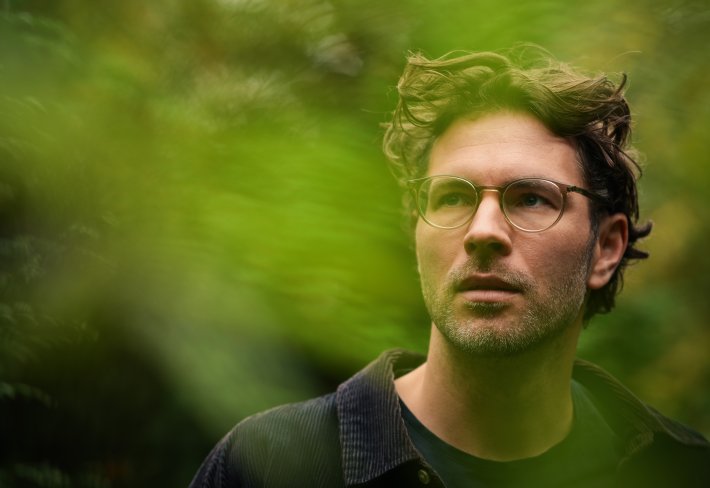
Danish singer-songwriter Frederik Damhus is entering a defining new chapter with Torrent Sound, a dreamy folk-pop project where intimate storytelling meets spacious, cinematic production. Drawing from the Scandinavian restraint of artists such as José González alongside the atmospheric experimentation of Bon Iver, Damhus creates music that finds significance in life's quieter moments.
That philosophy sits at the heart of debut album 'Helpless' and its lead single, ‘Colors’. What began with a light-hearted conversation about parenthood gradually became something considerably more profound, as Damhus reflected on how his children had changed the way he experiences the world. Built around acoustic guitar, dreamlike melodies and his warm, textured vocals, the song ultimately became a thank-you to the people whose seemingly small actions can quietly transform our lives.
So with the new single out now, we sat down with him to find out more about his origins and what has been inspiring him most over the years.
-
What was the first instrument you fell in love with?
The first instrument I fell in love with was actually the idea of a guitar. When I was five, my friend Jeppe and I decided we were going to start a band. His dad had an old Fender Precision Bass hanging on the wall, and we were completely fascinated by it. Jeppe was obviously going to play bass, and I was going to play guitar and sing. If I'd known back then that the entry ticket to that dream would be three years of recorder lessons, I might have thought twice.
Eventually, I did get a guitar. Then I discovered it was considerably harder to play than I'd imagined.
What kind of music did you love when you were younger?
I loved – and still love – big ballads. After my voice broke, I more or less taught myself to sing again by singing along to the ballads on Michael Jackson's HIStory and Savage Garden's Affirmation. I've listened to Two Beds and a Coffee Machine an absurd number of times. Those two albums probably had the biggest influence on the way I sing. Boyzone's Where We Belong was important to me as well.
Later, I discovered Thomas Dybdahl. …That Great October Sound was the first album I bought with money I'd earned from playing a show. That felt pretty significant: music had paid for more music.
What was the first album you remember owning?
When I was around ten, I started delivering newspapers, and quite a lot of the money I earned went on CDs that I played to death. The first one I bought myself was Absolute Music 7. It was one of those compilation series with the hits of the moment – including Rednex's Cotton Eye Joe. I still remember sitting very proudly on the train during a school trip, listening to it on my Discman. My taste in music wasn't exactly carefully curated at that point. What I bought could be pretty random.
What is the one song you wished you could have written yourself?
I wish I'd written Take Me Home by Tom Waits. It's probably the song that has meant the most to me in my adult life. I know it especially from an old, pixelated recording on YouTube, where Tom Waits is sitting at a piano and it sounds like there's a double bass playing with him. It's simply a feeling and a prayer, and it's incredibly clear. One minute and eighteen seconds of lament. That song has stayed with me ever since I decided I wanted to make music.
Robbie Williams recorded George Michael's Freedom as a kind of statement around his own breakthrough. I did something similar on my first album: I recorded my own guitar version of Take Me Home as a kind of “breakthrough song”. I love that song, and I'm also a little afraid of it. I've played it live from time to time, but I've sometimes been almost nervous about doing so. It's such a good song that I've worried the audience might leave thinking my own songs weren't very good. I suppose that's also a pretty good explanation of why I wish I'd written it.
Do you have any habits or rituals you go through when trying to write new music?
Thankfully, it's become easier. For the first ten years or so, I almost needed to be completely alone for days or even weeks before I could write. The silence, my thoughts and time itself almost had to stand still before I could climb into the songwriting bathtub. I've hardly written any songs at home in the city. I go away – usually alone to a summer house. I hate people being able to hear me write or practise. Ideally, I don't want to be able to imagine anyone standing on the other side of a wall listening.
Working with Alexander Grandjean on Helpless has taught me something important, though. He's much less interested in whether something is perfect than in whether you can feel it. He's said to me many times: “I can't really feel it. Try something else.” In a way, he's helped me get back to the approach I have when I'm completely alone in that summer house: no performance, no correct way of doing things. Just following whatever sound or idea feels interesting.
Who are your favourite artists you have found yourself listening to at the moment?
I'm not particularly good at constantly discovering new music. I tend to listen to the same artists and songs over and over again – and preferably live versions. At the moment, I'm completely fascinated by the sound of SYML's live album from Paris, especially Please Slow Down and Nobody Lives Here. I love it when you can hear the room, the person, and something that could only have happened in that particular moment. I think that's what I'm looking for in my own music as well: it can be beautiful, but it shouldn't become so perfect that the human being disappears.
If you could open a show for anyone in the world, who would it be?
My slightly boring answer is Elton John. But it's not really because of the size of his career. Of all the artists I've seen live, he's the one who sang with the most incredible clarity while somehow seeming the least affected by the fact that he was sitting on a stage in front of thousands of people. He just seemed completely at home. At one point, he joked that the guitarist was the youngest member of the band, even though they'd been playing together for decades. I'd love to have that kind of relationship with my musicians when I'm 76. Just standing there together and playing.
At the concert, my brothers and I were sitting very politely in our seats, almost at the very back. At one point Elton said something along the lines of, “How can you sit down to music?” So we rushed down through the venue. And suddenly all three of us were standing right at the front of the stage.
What do you find is the most rewarding part about being a musician?
My job is to give people a good experience. That's an absurd privilege when you think about it. When I play a concert, I sometimes have people's attention for almost two hours. That also means I get the chance to gently nudge them in a certain direction. Almost all of my songs are, in one way or another, about taking action – those moments when you feel something and realise you need to do something about it. I suppose I'm also trying, very gently, to persuade the audience to do the same.
After shows, I often have really meaningful conversations with people who tell me about something in their own lives that the concert made them think about. Sometimes I get the feeling that they feel as though they know me a little after the show. It creates a very special space in which to meet a stranger. You skip the small talk and suddenly you're talking about something that actually matters. That's a huge privilege.
And there's another thing: About half of my working life is spent doing exactly what I want to do, following ideas simply because I find them interesting. Who else gets to do that?
And what is the most frustrating part?
Nobody is actually asking you to make music. And nobody can really appreciate or understand what you're doing until they can hear or experience it. You can spend months or years working on something that, for a very long time, only exists inside your head, on an instrument and as a collection of files on a computer – while having to keep believing yourself that it makes sense. It's a strange bubble to live in.
On the other hand, it's pretty wonderful when the day finally comes when you can let other people into it.
And what is the best piece of advice you have received as a musician?
Find a partner with a real job. That's probably the most practical advice. But I don't really believe that advice can simply be transferred from one person to another.
If I had to give a more general piece of life advice, it would be to act on the thoughts and ideas that keep bubbling away in your gut. Follow your intuition – and share your thoughts with people you trust. My own ideas almost always become a hundred times better when I say them out loud and let other people react to them. And I think you have to accept that there isn't actually very much you can control anyway. So you might as well act on the things you can do something about.
-
Torrent Sound's new album 'Helpless' is out now. Check it out in the player below.