
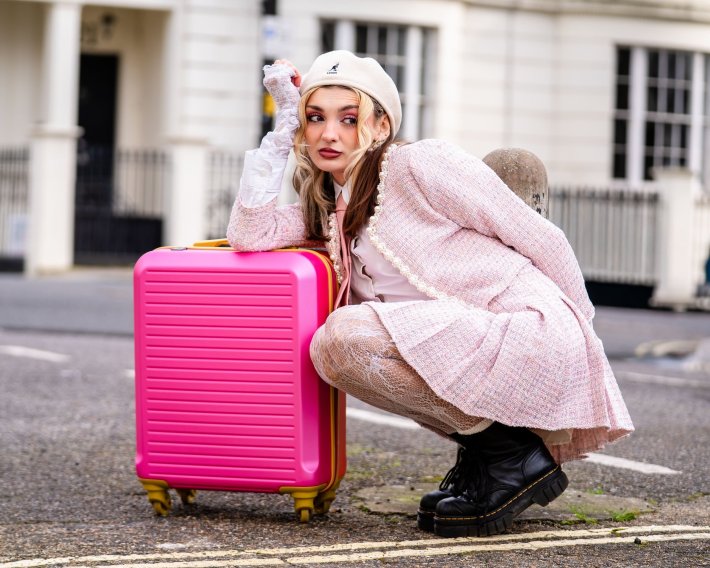
Rainbow Honour’s ‘Musician of the Year’ and Sex Education star LEXA is set to launch a bold new chapter with the release of her latest single “Baggage Claim”, as the lead track from her forthcoming EP, 'A Guide to Heartbreak'. Already commanding an audience of more than 190k followers, LEXA continues to push creative and cultural boundaries, combining infectious indie-pop songwriting with a commitment to meaningful representation and activism.
Co-written alongside songwriter SATCH and co-produced by Charlieeeee, 'Baggage Claim' makes history with entirely trans+ writing credits, while its bright guitar-driven energy draws inspiration from artists such as Scouting for Girls and Rachel Chinouriri.
So with the new single out now, we sat down with LEXA to discuss origins and influences over these last few years.
-
What was the first instrument you fell in love with?
The piano! My grannie had a gorgeous old grand piano that had been gifted to her by a friend, and some of my earliest memories were sitting at the piano stool learning songs with my grannie, from books that had my mum’s writing in from when she was a child herself. There is something so special about pianos; in the way that music holds history, pianos are a time capsule of so many stories, so many songs both new and classical, and I find it’s a very special instrument to write on when each ivory key feels so unique.
What kind of music did you love when you were younger?
I was raised on indie rock. Though not musicians themselves, my parents are big music fans. Their love for Britpop and bands in the 90s definitely seeped into my childhood. Some of the particular records I remember rotating through on long car journeys were ‘Costello Music’ by The Fratellis, ‘Not Accepted Anywhere’ by The Automatic and most definitely a sprinkling of Scouting For Girls and Arctic Monkeys. My appreciation of a more electronic sound, that still influences my own music, was nurtured by my mum’s love for Fat Boy Slim and Mark Ronson, with my dad’s adoration for Gorillaz and The Scissor Sisters.
What was the first album you remember owning?
Unfortunately, the story of my first album is now somewhat of a tainted one. As a young trans girl, I had a yearning for the ultra feminine and the power of strong women. As a 9 year old who felt out of place, when I first heard Nicki Minaj on the radio with ‘Superbass’ and beheld her 19 inch pink wig on 4Music, I instantly became a fan. To think Minaj was such a figure of powerful womanhood and progression, loved by so many queer people, it truly breaks my heart to think she has turned her back on that part of her identity. I theorise her motive: to garner more money, more power or as a hope to find more stability, perhaps? We lost an icon and gained another plain clothed, brain-washed mouthpiece.
What is the one song you wished you could have written yourself?
One of my all-time favourite artists and huge inspirations in my new sonic direction is indie artist, Cavetown. The song ‘Tarmac’ on his new album, in particular, is this infectious combination of nostalgic indie-rock, with an injection of electronic, avant-garde production style and symbolic lyricism. Honest, catchy, thick, poetic and led by a true ROCKSTAR, it’s a song I wish I had the honour of saying I had written or produced but am happy to be blessed with the master either way.
Do you have any habits or rituals you go through when trying to write new music?
My belief is that if you follow the Title, Concept, Subject rule it tends to lead to pretty good songwriting. The TCS method is the idea that if you are moved to write about a certain subject, find an interesting and unique concept, metaphor or symbolism in which to explore the theme and a title to cement that concept and then you can’t go far wrong. For me, however, these sometimes appear in different orders. In some cases, there is something happening in my life I can’t avoid exploring musically, and that leads to a concept; in others, I’ll be on a bus, in a meeting, or have an idea triggered by a passing comment from a friend and a title or song concept will pop into my head … leading to a very long list currently taking up phone storage in my notes app.
Who are your favourite artists you have found yourself listening to at the moment?
Cavetown, as mentioned, as well as the women that make indie-rock feel accessible and COOL to me: Rachel Chinouriri, Beabadoobee, Su, I think and Devon Again.
If you could open a show for anyone in the world, who would it be?
Let me say it again…….. CAVETOWN! The trans power would make me very emotional.
What do you find is the most rewarding part about being a musician?
There is an intense tenacity required to be able to continue working as a musician, which speaks to how rewarding and special music is, or no one would have the strength to survive it. My friend and trans songwriting extraordinaire, SATCH, told me recently that “birds call in the morning to let each other know they survived the night. That’s what music is for us. It’s how we let each other know we survived the night”, which beautifully encapsulated what I adore the most about music. The vulnerability of exploring pain through songwriting not only provides catharsis and relief, but allows me to connect with others. It’s a cliche, but knowing even one person has felt seen and held by my music would be beyond rewarding, so hearing from so many gorgeous people over the years, who also suffer with TSW (Topical Steroid Withdrawal) or identify as trans+, tell me that my candid songwriting and persistence in releasing music has been comforting or beneficial to them is a DREAM COME TRUE.
And what is the most frustrating part?
Music is healing. The music industry is a business. It’s a hard truth to hold in conjunction, because whilst I encourage vulnerable writing and impulsive musicality, there are benefits to structure, extensive planning of music projects and artist marketing development in order to turn music into a viable career, which can feel reductive to true artistry. True creativity is something confined to the HUMAN experience, but AI doesn’t need to sleep and eat and pay bills, and that is a hard thing to compete with. In an oversaturated industry, with an increasingly limited number of record deals and paid opportunities, the most frustrating thing I find is the overwhelming sense of guilt that tints my life. I feel guilty for working too hard and putting too much money and time into a dream, I feel guilty for not seeing my family and friends enough, I feel guilty for not looking after my body, but then I feel guilty every time I step away from work, feeling like I am not trying hard enough, not doing everything right, feeling guilty for sleeping too long after a shift because I should be using that time to create a new press launch, produce a new single or write a track for SYNC. It’s hard finding a balance in an industry built off fear mongering, telling you that you need to work harder than everyone else, be different, but copy artists' careers from a completely different generation. THE CONTRADICTIONS?!
And what is the best piece of advice you have received as a musician?
Funnily enough, one of the best pieces of advice I’ve ever received wasn’t even from a musician but a media producer. Like most musicians, I am a cocktail of insecurities and often struggle to self-promote, particularly in finding a ‘brand’, which I was moaning about to my friend Connor when he offered this piece of advice. He said: “well, imagine you’re the main character of a book. What parts of you would you include? What would make you the most interesting protagonist?” I was gooped. It can feel reductive or restrictive attempting to control your artist persona, online especially, but in fictional story-telling you wouldn’t oversaturate a character with too many conflicting identities or information. That doesn’t make them uninteresting, it can make them resonate with more people, and I think that’s a good way to view self-promotion and artist branding.
-
LEXA's new single 'Baggage Claim' is out now. Check it out in the player below.