
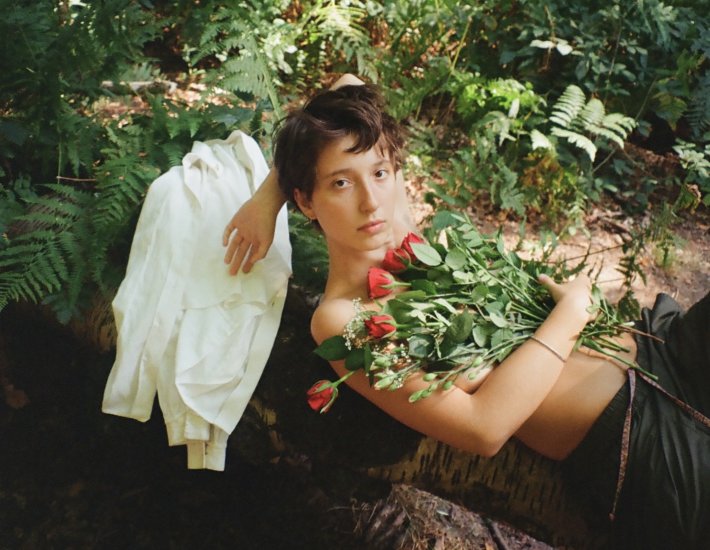
Across a decade of writing, refining, and remembering, Paloma León has been shaping what has now become her most ambitious project to date: 'Piano Music for Movies'. Recorded on a Steinway baby grand at London’s Porcupine Studios, the album captures the Los Angeles-born, London-based pianist and composer’s evolution from prodigious beginnings to a bold new voice in contemporary classical music.
Blending tradition with cinematic scope, León’s work is entirely her own, stored in memory rather than on the page and performed with a rare emotional depth. Its spellbinding lead single 'Sunfish' is a deeply personal tribute to her late father, weaving innocence, grief, and love into cascading themes that are at once virtuosic and profoundly human.
So with the new single out now, we sat down with Paloma to discuss her origins and what has been inspiring her sound most over the years.
-
What was the first instrument you fell in love with?
The first instrument I fell in love with was the Piano. In no way was it an easy first love. It was a complicated, turbulent love. It was love I had to come to from understanding, patience, and acceptance — of myself, the instrument, and the circumstances in which I learned how to play. My late father, Garby, was a concert Pianist. He decided that I would begin lessons at the age of 5.
I was taught by some traditional Russian teachers. A lot of the experiences were comical. For instance, I grew up as a super tomboy, and I remember one of the tougher ones, Mike, bought me a hot pink binder with an Ed Hardy-esque felt heart that said “Wild Heart” on it. My dad didn’t want to disrespect him, so I had to use it for years, and accept dried prunes with performative glee after every lesson (very sweet, though — thanks, Mike!). But it was a lot.
The first piece I ever learned was “Brother John” on the Piano as a toddler. It was literally one of the most traumatic experiences of my life. Regardless, learning the Piano so completely gave me a universe of tools to use, and a universe at large.
What kind of music did you love when you were younger?
When I was in high school, I constantly blasted Crystal Castles. Around 2017, that lush, super-heavy, euphoric, drug music was in, and I couldn’t get enough — especially “Not in Love” (featuring Robert Smith from The Cure). I remember that screeching chorus filling me with manic inspiration as a teenager.
Same as Karman’s 2005 Forever — “Ur All I Want” and “Cry 4 Us” made me eager to create. Ricky Eat Acid was another favourite, along with Mozart’s Requiems, Sky Ferreira, Yung Lean, Paris Hilton, Arca, and Liszt and Chopin. I think I was collecting data for my compositions. Ultimately, I was interested in melody and emotion, rather than learning how to traditionally compose within a classical framework.
I remember the music department kids thinking I was a degenerate for this. They were always on about Mahler, and I liked Schoenberg ironically. I guess I still come across these band kids, who are now adults, and they still think I’m a degenerate. But that’s a good thing. They can carry on — I am a degenerate, and that’s why my music is good.
I went to Santa Monica High School, and the visuals of that place are deeply tied to that eclectic collection of music. I remember staring at the Pacific Ocean and feeling the vastness of the world, deliberately getting off the bus late so I could walk around school with my headphones in. It was impossible to tear me away from constant music listening. To be fair, it’s still impossible now.
Being that age is so hard, but it’s also incredible — you are so buoyant, and you see things adults don’t. It’s the best time to love music. Your brain fibres will always remember your high school favourites, and you’ll be surprised how much it informs your work even years down the line.
Honourable mentions are also Salem, especially “King Night,” Frank Ocean’s Nostalgia Ultra, and Blank Banshee.
Pop music, or pop-adjacent music, is so important in informing my work. It’s cyclical — pop music is informed by classical music, and then I write modern classical music, enhancing pop themes in my head.
Aside from that, I also adored the Synecdoche, New York score by Jon Brion (one of my favourite film composers), and Comedown Machine by The Strokes — that kind of drab 80s-inspired guitar music that carried me through to my love of “brighter” guitar music and fingerpicking, like Elliott Smith, Labi Siffre, and Nick Drake. The texture created by folky guitar music was crucial in shaping my more impressionistic pieces (like Sunfish, Piano Music for Movies). I feel like it evokes a lot of emotion — plucking.
What was the first album you remember owning?
My dad got me the complete collection of the Goldberg Variations on CD when I was a kid. And although I watched those religiously, the first album I chose to own was The Wall by Pink Floyd.
My mom got me into “Comfortably Numb” when I was 11 or so, and I was hooked. I was captivated by the idea of a concept album at the time. I love world-building. Typically, music will accommodate a visual artform in order to world-build, but in this instance, the concept was solely of Pink Floyd’s collective brain.
From a musical standpoint, The Wall balances light and dark brilliantly — from the delicate (although foreboding) “Goodbye Blue Sky,” to the hellish “The Trial,” with proto-80’s dance bops like “Run Like Hell” chucked in there. I think it’s a masterful and deeply complete body of work.
Pink Floyd became way more relevant in my life because I moved to Britain as a teenager, and the “quiet desperation” described in their music became a real element of my life — which is bizarre to think about. The lyrics often eviscerate British culture, but discovering that these were fair indictments placed important political significance in their work for me. It made me aware of the Britain of yesteryear, and how that’s informed the Britain of today.
What is the one song you wished you could have written yourself?
When I was 18, I was trying to write an extended part of Tangent of a Butterfly: Movement II (Piano Music for Movies), and I had come up with this melody I really liked. I showed my friends, and it turned out — sadly — that it was the main theme from La La Land, and it couldn’t be used. It would have been a great addition, but Justin Hurwitz beat me to it.
Do you have any habits or rituals you go through when trying to write new music?
Scales. All of them. Up the circle of fifths. I like to play Chopin’s Ballade No. 1 in G Minor, too. I also have a maladaptive daydreaming problem. I’ll throw on some music and wander around my house for a few hours to get the juices flowing.
Who are your favourite artists you have found yourself listening to at the moment?
Fontaines D.C. — I think Grian Chatten is excellent at telling the truth, which makes him a solid poet. I love their approach to world-building, too: “what’s the weather of this song?” they ask when they jam. I’ve taken that idea into writing rooms, especially for my upcoming performance at the Royal Albert Hall with a pop artist. It’s special to connect on that realm, and when you’re working cross-genetically, non-music speak is important. I’m also in an art rock duo with Gaika. We made a record called Dogtown, our process was just talking for hours, watching YouTube videos and having a laugh.
Honestly, I’ve been mixing my record intensely for the past months. I mixed it all myself. I keep wanting to come back to it. I’ve been listening to Piano Music for Movies!
Honourable mention: Tomasz Trzcinski
If you could open a show for anyone in the world, who would it be?
I’d love to do some pre-show ambient classical piano for Fontaines or Thom Yorke. I’d love to work with Nala Sinephro, too. Hania Rani, Nils Frahm, and Emile Mosseri would also be on my list.
What do you find is the most rewarding part about being a musician?
Collecting endlessly.
And what is the most frustrating part?
The inundation with opinions from people. Best to unplug and shake off the strange things that attach to you.
And what is the best piece of advice you have received as a musician?
Calm down!
-
Paloma León's new single 'Sunfish' is out now. Check it out in the player below.